In 1833 George Hudson, the Chairman of the North Midland Railway, was in
discusions about the possibility of building a railway to York from Leeds which
was completed in 1839. Hudson had also commisioned George Stephenson to build
the railway from Derby to Leeds which was completed the same year. The
following year the York and North Midland Railway established a line from
London to York and by 1845 the line northward had reached Edinburgh, forming
the line know today as the East Coast Main line. York was an important junction
on the route to Scotland and in 1842 workshops for locomotives and carriages
were built.
The "branch" to Scarborough was completed later in 1854. In that
year the three companies, York and North Midland, Leeds Northern and the York,
Newcastle and Berwick amalgamated to form the
North Eastern Railway with its administrative headquarters at
York.
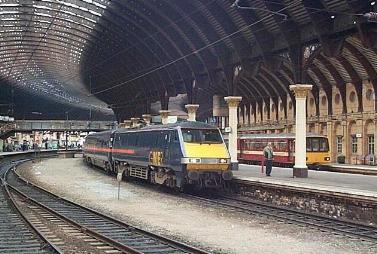
In 1873, with the increase in traffic, it was decided to build a new station
at York which was completed in 1877 and had 13 platforms. This is the one you
can see today. At that time it was the largest in the world and one of the
greatest buildings of the Victorian age.
In 1923, the North Eastern Railway became part of the
London & North Eastern Railway, of which York was one of
the principal centres.
York is
situated in the North East of England. 210 miles from London. Train services
between Kings Cross, York and Edinburgh are operated by
GNER with a journey
time from London of less than two hours (but allow 4 hours by road - on a good
day!).


 ©
© 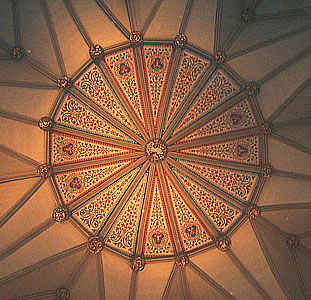 This is the wooden ceiling of the
Chapter House of York Minster, the largest medieval Gothic church in northern
Europe, which was completed in 1472.
This is the wooden ceiling of the
Chapter House of York Minster, the largest medieval Gothic church in northern
Europe, which was completed in 1472.