This simulation covers the busiest part of the area controlled by Leicester
Power Box, 8.5 miles between the Syston triangular junction and Wigston North
Junction.
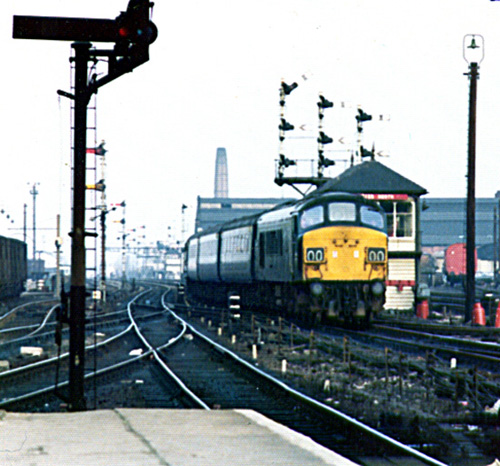
A Peak approaches
Leicester London Road Station from the north. Note the array of semaphore signals that can be seen on this
stretch of track, the ex-Midland signal box, and the former shed complex on the
right.
Black 5 4-6-0 45024 passes Wigston North Junction box with an up relief composed mainly of ex LNER stock on 15th August 1959. Photo: David Greening, in "Steam around Leicester", publ. 1982.
A challenging Heritage signalbox, with the convergence of 3
routes - traffic on the Midland Main Line from St. Pancras is joined here by
trains from both the Nuneaton and Rugby lines for the final 3 miles northwards
to Leicester.
The Midland Main line was built between the 1830s and the 1860s largely by
the Midland Railway company, the Leicester to London stretch of the line was
built in the 1860s to relieve an earlier route to London via Rugby which had
been built by the Midland Railway's predecessor the Midland Counties Railway
and had become very congested.
The Midland Railway owned a large network of railway lines centred on the
East Midlands, and its head offices were in Derby. The MR's main line known
unsurprisingly as the Midland Main Line connected London St Pancras station to
the East Midlands and to Sheffield Midland station. The company also owned a
main line connecting the East Midlands to Birmingham and Bristol and a main
line connecting Derby to Manchester. In the 1870s a dispute with the London and
North Western Railway over access rights to the LNWR line to Scotland caused
the MR to construct the Settle and Carlisle (S&C) line, the highest main
line in England, in order to secure the company's access to Scotland;
ironically the dispute with the LNWR was settled before the S&C was built,
but Parliament refused to allow the MR to withdraw from the project. They also
owned a number of less important lines.
Let us know what you think of our
Special Feature on Leicester. We will welcome your suggestions for future
features.
Why not visit one of the excellent Leicester Pubs?
At the hub of the Midland Main Line route is Leicester, a city full of
entertainment, history, and shopping. The city's ethnic diversity has enabled
Leicester to become a national focus for many festivals and cultural events
throughout the year.
The station on London Road still has its original brick facade. Photo by
Jonathan Rawle
Leicester is situated in the East Midlands, with a population of 280,000. The city is on the Midland Main Line between London and Sheffield and high-speed trains operated by Midland Mainline can reach London in just over an hour. It is also served by Central Trains services to Birmingham and Coventry via Nuneaton, and a variety of destinations including Norwich, Cambridge, Liverpool,
Manchester and Lincoln.
The urban area spreads outside the boundaries of the city proper, and includes Oadby, Wigston, Braunstone Town, Glenfield, Blaby and Syston.
As well as being a major railway centre, there are many other things to see and do in Leicester.
By 1832 railways had arrived in Leicester with the opening of the Leicester
and Swannington Railway which provided a supply of coal to the town from nearby
collieries. By 1840 the Midland Counties Railway had linked Leicester to the
national railway network which further boosted industrial growth.
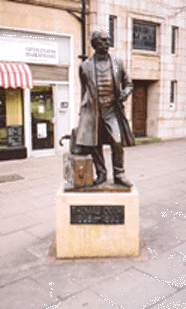
A statue in front of
Leicester's London Road railway station commemorates a world-famous travel
pioneer. Thomas Cook's first-ever railway excursion took local workers from
Leicester to Loughborough on 5 July 1841.
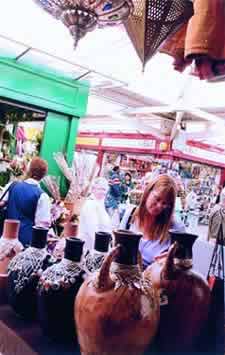
Leicester Market is home to the largest covered market in Europe and is
located in the heart of the city centre.
Leicester is one of the oldest cities in England with a history going back
nearly 2000 years. Traders first came to the city with
the Romans and the current market has been on the same site for 700 years.
Major industries in Leicester today include food processing, hosiery,
footwear, knitwear, engineering, electronics, printing and plastics. Leicester
is home to two universities, the University of Leicester and De Montfort
University and has an Anglican cathedral of St Martin's.



 The Midland Main line was built between the 1830s and the 1860s largely by
the Midland Railway company, the Leicester to London stretch of the line was
built in the 1860s to relieve an earlier route to London via Rugby which had
been built by the Midland Railway's predecessor the Midland Counties Railway
and had become very congested.
The Midland Main line was built between the 1830s and the 1860s largely by
the Midland Railway company, the Leicester to London stretch of the line was
built in the 1860s to relieve an earlier route to London via Rugby which had
been built by the Midland Railway's predecessor the Midland Counties Railway
and had become very congested.
 A statue in front of
Leicester's London Road railway station commemorates a world-famous travel
pioneer. Thomas Cook's first-ever railway excursion took local workers from
Leicester to Loughborough on 5 July 1841.
A statue in front of
Leicester's London Road railway station commemorates a world-famous travel
pioneer. Thomas Cook's first-ever railway excursion took local workers from
Leicester to Loughborough on 5 July 1841.